Author Archives: daniel
An advantageous location
Thanks to its location near the main roads, airports and border crossings, Iłowa is a perfect place to start your business in western Poland.
Border crossings:
Iłowa, is located next to the border with Germany and the Lower Silesia Voivodeship in western Poland. At a distance of up to 45 km from the town, there are four large border crossings between Poland and Germany:
- Przewóz – Podrosche: 25 km
- Olszyna – Forst: 40 km
- Łęknica – Bad Muskau: 40 km
- Zgorzelec – Ludwigsdorf (Görlitz): 45 km.
Road connections:
Iłowa is situated near the motorway junction connecting the A18 motorway (Berlin – Wrocław – Lviv) and the Zielona Góra – Żagań – Lubań – Zgorzelec national road.
Iłowa is situated at a distance of around 50 km from the S3 expressway (Szczecin – Gorzów Wielkopolski – Nowa Sól – Legnica – Lubawka).
The A4 motorway (Olszyna – Wrocław – Katowice – Kraków – Rzeszów – Korczowa), in turn, is situated at a distance of 35 km from Iłowa.
The municipality of Iłowa constantly invests in local roads. A connecting road between the economic zone in Iłowa and the provincial road No. 296 will be completed in 2018. Pułaskiego Street was modernised in 2017: the road surface was renewed and sidewalks and drainage were created.
Railways:
Iłowa is situated on the railway route from Żary to Węgliniec. Direct rail links to Żary, Zielona Góra, Zgorzelec and Jelenia Góra are maintained and serviced here.
Air transport:
Nearby passenger and cargo airports are in Babimost near Zielona Góra and Wrocław in western Poland and in Berlin in Germany.
Traces of the past
The vicinity of Iłowa is also a perfect place for enthusiasts of ruins and manor architecture. In the village of Borowe, which is situated at a distance of 5 km to the west of Iłowa, there are the remains of a manor built at the turn of the 16th and 17th centuries, which at that time was owned by the Promnitz family. Nearby there is a park with preserved specimens of horse chestnuts, beeches and maples. It is also worth visiting the village of Czerna, situated at a distance of 5 km to the north-east of Iłowa. An interesting reminder of the history of this place is the complex of ruins of the palace built at the turn of the 19th and 20th centuries by Friedrich Glöckner, who owned the local ironworks and foundry, opened in the 15th century. These works were pulled down after World War II.
Attractions around Iłowa
Around the town of Iłowa you will find some very interesting monuments of technology and architecture of western Poland. In the village of Jankowa Żagańska, it is not impossible not to notice the unique water tower built in the expressionist style. Its dynamic silhouette, made of red brick, picturesquely matches the surrounding nature. It is the only structure in Poland designed by the German architect Otto Bartning, co-founder of the Bauhaus.
Old railway junction
Jankowa Żagańska is also an unmissable stop for enthusiasts of monuments of technology. Here, the oldest railway junction in the Lubuskie Voivodeship was built in 1846 by the Jankowa Żagańska – Żagań – Głogów railway and the historical Berlin – Żary – Węgliniec – Legnica – Wrocław railway.
Historic church
In the historic Saint Bartholomew Church in the village of Konin Żagański, you should pay attention to the gravestone of the village owners, Christoph and Helena von Schollendorf (around 1600), and the Renaissance tombstone of Heinrich von Schollendorf. Another real asset of the temple is the bell, dating back to 1586, and decorated with a beautiful Renaissance ornament and a picture of the Mother of God.
Historic Żagań
Visit Stalag Luft III where the the famous Great Escape took place
When coming to Iłowa, it is also worth visiting the capital of the poviat, Żagań, the former German city of Sagan. The Air Force Prisoner of War camps run by the Luftwaffe, called Stalag Luft (short for Stammlager Luft) or Permanent Camps for Airmen, were situated in Sagan, 100 miles south-east of Berlin. Here you will find the Museum of POW (Prisoner of War) Camps. In March 1944, 76 prisoners escaped from the with the Stalag Luft III, using an underground tunnel called “Harry” with a length of 110 m dug by them. But only three of the prisoners were successful. This was the story on which the American film “The Great Escape” (1963) with a star-studded cast was based. Every year, in March, subsequent anniversaries of the Great Escape are celebrated within the camp’s territory.
In the museum there are exhibitions of:
- “Tunnel Dick”
- “The Long March” – the evacuation of the Zagan prisoner-of-war camps
- “The Wooden horse” escape
- “The Great Escape”
- “The French in Stalag VIII C”
Location and contact information
Museum of POW Camps
Lotników Alianckich Street 6
68-100 Żagań
phone: +48 68 478 49 94
Tourist information
Szprotawska Street 4 (Ducal palace)
68-100 Żagań
phone: +48 68 477 10 01
e-mail: it@um.zagan.pl
Opening hours
Tuesday – Friday: 10:00-16:00
Saturday – Sunday: 10:00-17:00
Jewel of organ art
The musical symbol of Iłowa is the organ in the Christ the King Church, which is a jewel of organ building in the Lubusz Land. The first instrument, which had been ordered for the church was built in the 18th century by an organ builder from Żary, Georg Adam Caspari. In the 1930s the new 28 pipe organ was built by the German „E. Kempper & Sohn” company.
Summer Organ and Chamber Music Festival
Visit the Summer Organ and Chamber Music Festival, which has been held in Iłowa since 1998. You will hear artists from countries all over the world, for example: Poland, Germany, the Netherlands, Latvia, France, the Czech Republic, Switzerland or the USA. The king of instruments is repeatedly accompanied by the harmonica, harp, pan flute, cimbalom, oboe, flute, harpsichord, violin or trumpet. In summer, concerts are held on every Sunday in May.
Location and contact information
Manor park
The manor park is not only a masterpiece of garden art, but the romantic scenery is also a perfect background for photography sessions. At the start of the 20th century, Frederic von Hochberg zu Fürstenstein, ho was the owner of the park and the palace in 1902-1921, decided to enlarge and remodel the park along with the latest Art Nouveau fashion in landscape design. In the old part of the park, there are the English and the French gardens.

A master piece of garden art in Iłowa
The first Japanese garden in Europe
The Japanese garden, with a tea house, lanterns made of stone and small bridges, is of a particular value – it was the first Japanese garden in Europe! It was established at the beginning of the 20th century on the initiative of Count Friedrich von Hochberg zu Fürstenstein, an enthusiast of garden art and an expert on Oriental art. He was a passionate traveler and served as Germany’s ambassador to Japan. The layout of the paths and canals, and the artificial lake and islands have been preserved until the present day.
-

- Beautiful fountains

-

- Beautiful fountains in the park

-

- Japanese garden

-

- Japanese garden in winter

-

- Japanese garden

-

- Take a break on a bench near a fountain

The Japanese garden in Iłowa is one of approximately 7 Japanese gardens open to the public in Poland. The most famous of these is located in the Szczytnicki park in Wrocław. It is one of the few traces that are left after the world exhibition organised in 1913. Also this garden this garden was designed and created by Count Frederic (Fritz) von Hochberg.
Chinese garden
In the Chinese garden you will find the Moon Gates – two brick walls with oval and circular openings. Having passed through them, you will reach the Bridge of Love, with a Chinese pagoda.
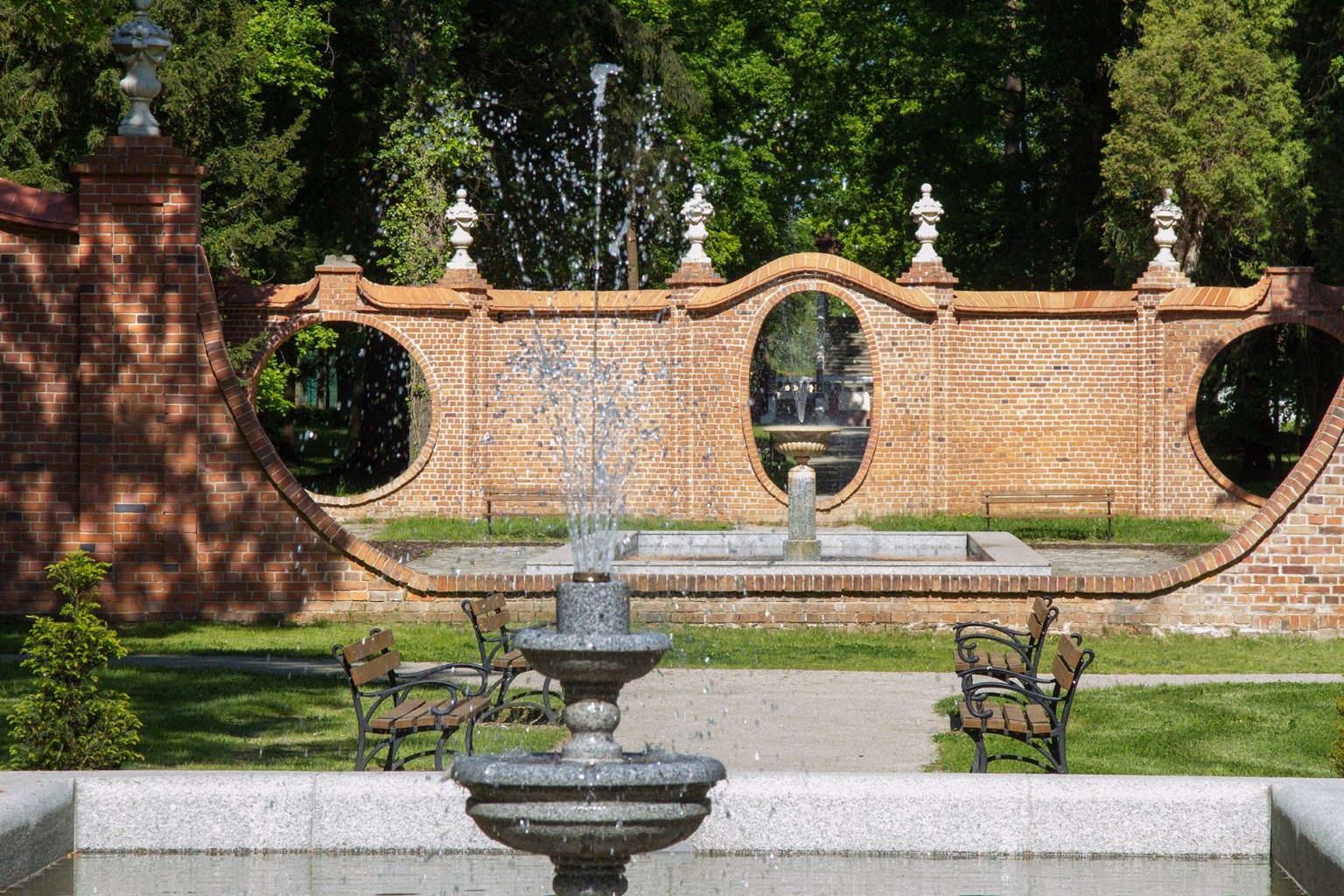
The Chines garden with moon gates
Colourful flowers
The gardens in Iłowa are in blossom from early spring. If you come here in May, you will experience a real feast for your senses in the impressive rhododendron grove, planted on both banks of the river Czerna flowing through the estate. The magnificent shrubs with colourful flowers in various shades of red, purple, yellow and pink will charm everyone. In the park, you will also see numerous interesting fountains. It is worth paying attention to the oak and horn beam path, several magnificent lindens, maples, alders and yews, and the rose garden.
-

- Rhodondendron (Photo: Hilde Mertens)

-

- Rhodondendron (Photo: Hilde Mertens)

-
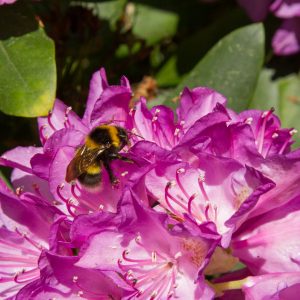
- Rhodondendron

-

- Dahlia

-

- Dahlia

-

- Dahlia

Main entrance to the park: Pałacowa Street
Admire the manor park in Iłowa in all seasons: spring, summer, autumn and winter.
Location and contact information
Kingdom of dahlia
The first dahlias in Europe were grown in Iłowa in the Lubuskie Voivodeship. The person who contributed to the development of local gardening in the 17th century was Count Friedrich von Promnitz. It was in his reign that the town was granted an urban charter and the unique coat of arms with an image of a dog. Another contributor to the industrial development of gardening was the Winkler family. The dahlias and orchids grown by them were used e.g to decorate German passenger liners before World War II. Iłowa was also made famous by two dahlia exhibitions organised in the 1930s. The 1938 exhibition was visited by as many as over 35,000 people. in 1939 1,000 dahlia varieties and the achievements of the local fruit growers, such as grapes and peaches, were presented here.
-
- Dahlia
-
- Dahlia
-
- Dahlia
Manor park Feast
The idea of a flower exhibitions was resumed in the 21st century. Every year in May the Manor Park Feast is held, during which interesting varieties of flowers grown in the town’s immediate vicinity are presented. Be our guest!
The Lower Silesian Wilderness
Near Iłowa, there is a real treasure of nature. The Lower Silesian Wilderness (Bory Dolnośląskie) is the largest continuous forest complex in Poland. The Lower Silesian Wilderness
The palace in Iłowa
To enter the park complex, you need to pass through a beautiful half-timbered gate. In the park, where the Czerna Mała River flows, your attention is immediately drawn to a two-winged palace built in the Renaissance and Baroque periods. At the turn of the 19th and 20th centuries, a tower and terraces were added to the building.
Palace in Iłowa – jewel of oriental art
These changes were initiated by the then owner of the palace, Count Friedrich von Hochberg zu Fürstenstein. Inspired by Japanese art, he introduced elements of Oriental art into the palace architecture and decor. Similarly to Friedrich von Promnitz, Count von Hochberg zu Fürstenstein was also a great enthusiast of dogs – he even built a racetrack for them, and a cemetery with epitaphs. Despite the partial devastation and plunder of the palace during World War II, some elements, such as the beautiful stucco work and wooden stairs with a balustrade, have survived till the present day. It is a real feast not only for enthusiasts of architecture. Today, the building houses the Post-Junior High School Complex.
Location and contact information
Post-Junior High School Complex
Pałacowa Street 1
68-120 Iłowa
tel. +48 68 377 43 14


Recent Comments